
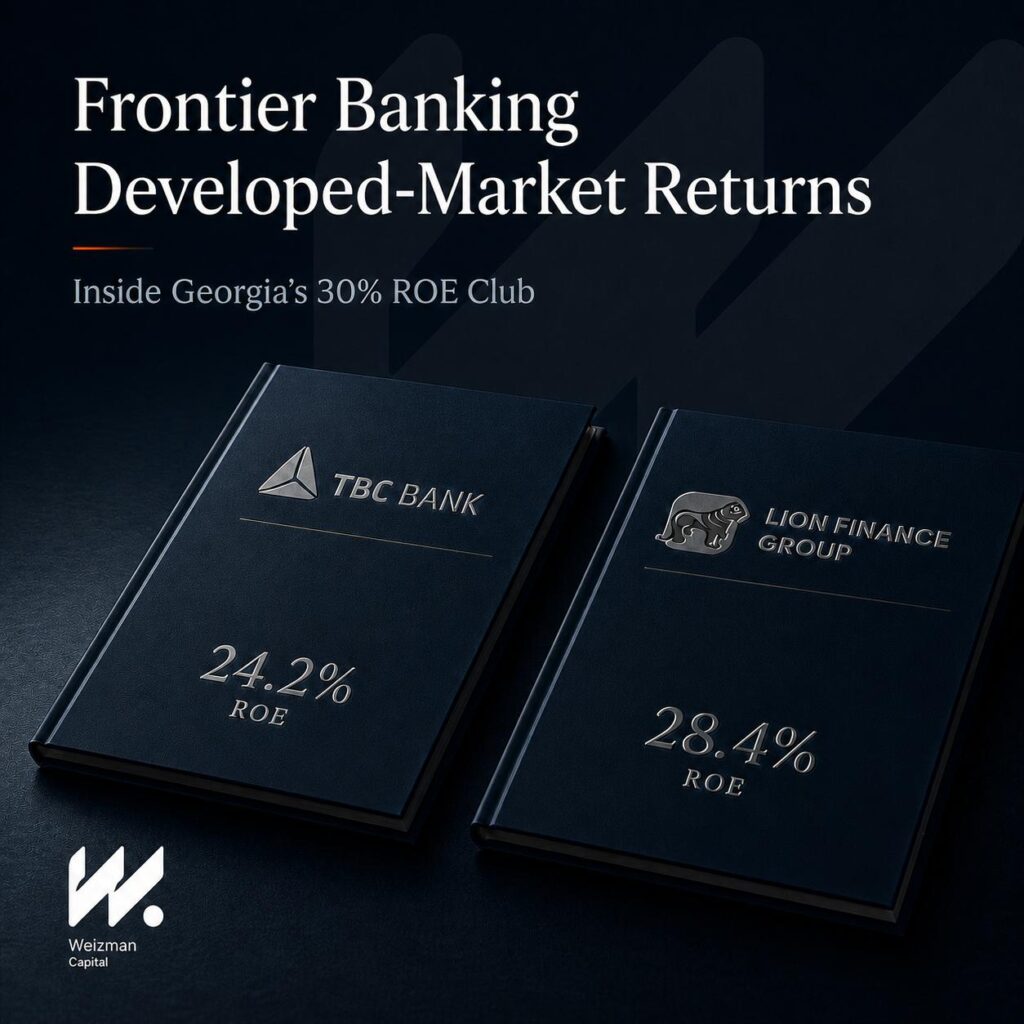
Two LSE-listed banks. Combined profits of $1.3 billion. Return on equity that rivals the best-performing financial institutions anywhere in the world.
In most frontier markets, banking sector profitability is a story of high margins compensating for high risk: elevated NPLs, fragile deposit bases, and occasional currency crises that periodically wipe out several years of accumulated returns. Georgia’s banking system does not fit that template.
In 2025, TBC Bank Group reported net profit of GEL 1,420 million (approximately $530 million) with a full-year return on equity of 24.2% and a fourth-quarter ROE of 24.9%. Lion Finance Group, formerly Bank of Georgia, reported a profit of GEL 2,193 million with an adjusted return on average equity of 28.4% for the full year. Its Georgian Financial Services division posted 32.0% ROAE for the year and 32.7% in Q4 alone.
Combined, the two institutions earned approximately GEL 3.6 billion (roughly $1.3 billion) in net profit from a country of 3.7 million people.
For context, JPMorgan Chase delivered 17% ROE in the same quarter. Georgia’s banks are outperforming some of the most efficient financial institutions in the developed world.
AND these are not anomalous results driven by a single favorable quarter. TBC Bank’s five-year compound annual net profit growth rate stands at 35%, with an average ROE of 26% across the cycle. This is structural profitability, not cyclical luck.
Why the Returns Are This High
Georgian banking profitability is the product of a specific market structure that is difficult to replicate and, for now, difficult to disrupt.
#1 first factor: concentration.
TBC and Lion Finance together control approximately 75% of the banking system’s assets, with Lion Finance holding 37.8% of loans, 41.0% of deposits, and 46.1% of retail deposits. In a rapidly growing economy, a concentrated duopoly with dominant deposit franchises generates natural operating leverage – revenue scales faster than costs, and pricing power remains intact.
#2 second factor: digital infrastructure.
Both banks have invested aggressively in digital platforms that now serve as their primary customer interface. TBC’s digital monthly active users exceeded 1.3 million in 2025, up 24% year-over-year. Lion Finance won Global Finance’s “World’s Best Digital Bank” award for the second consecutive year. These platforms reduce cost-to-income ratios while increasing customer stickiness, a combination that directly supports margin expansion.
#3 third factor: asset quality.
Non-performing loans across the banking system stood at 2.47% as of January 2026. Lion Finance reported a cost of credit risk of just 0.3% in Q4. These are not the asset-quality metrics of a frontier banking system taking excessive risk to generate returns. They reflect conservative underwriting in a growing economy where employment is rising, wages are increasing, and the corporate sector is performing.
#4 fourth factor: the rate environment itself.
With the NBG’s policy rate held at 8.0%, banks earn a healthy net interest margin on GEL-denominated lending. High rates, which would normally suppress credit demand, have not done so in Georgia: total system loans reached GEL 71.1 billion in February 2026, growing 13.6% year-over-year in nominal terms and 14.2% excluding exchange-rate effects. Household lending ( consumer credit and mortgages ) has been a meaningful contributor to this growth.
The Growth Vectors Beyond Georgia
What distinguishes TBC and Lion Finance from most frontier bank equities is that their growth story is no longer confined to a single small market.
TBC Bank has expanded into Uzbekistan, where its operations already contribute 9% of group profit. At its February 2026 Strategy Day in New York, TBC set a 2030 vision of net profit exceeding $1 billion, effectively doubling current levels with loans above $20 billion and 12 million digital monthly active users across its markets. The Uzbek franchise gives TBC access to a 36-million-person economy with similar structural characteristics to early-cycle Georgia: underpenetrated financial services, a young population, and rapid digital adoption.
Lion Finance has consolidated Ameriabank in Armenia, adding a second market with a growing economy and a banking sector at an earlier stage of the same digital transformation that Georgia has already undergone. The Armenian operation is now contributing to group earnings and provides geographic diversification that reduces single-country concentration risk.
Both institutions trade on the London Stock Exchange, offering international investors liquid access to these return profiles without the operational friction of direct frontier-market participation.
The investment thesis is evolving from “Georgian banks with exceptional returns” to “Caucasus-region digital financial platforms with Georgia as the proven core.” That is a fundamentally different proposition for institutional allocators.
The Durability Question
The natural scepticism toward 25–30% ROE in a frontier market is whether it can persist. There are three structural reasons to believe the answer is yes for the medium term, and one risk factor worth monitoring.
The first support is credit penetration. Despite double-digit loan growth, Georgia’s private credit-to-GDP ratio remains below the level at which banking systems in comparable economies have historically peaked. There is room for the loan book to grow before saturation concerns become relevant.
The second support is de-dollarisation. As the economy gradually shifts toward GEL-denominated lending and deposits, a trend reinforced by the corporate bond market’s own GEL pivot, banks benefit from improved monetary transmission and reduced currency mismatch on their balance sheets. This makes earnings more predictable and less vulnerable to exchange-rate shocks.
The third support is operational leverage from digital platforms. The marginal cost of serving additional customers through mobile banking is near zero. As user bases grow and transaction volumes increase, the cost-to-income ratio has structural room to decline further, supporting margins even if competitive dynamics eventually compress pricing.
The risk to monitor is credit cycle maturity. Household loan growth is strong, and consumer lending is a meaningful contributor to system expansion. If the economy were to slow materially, or if the 8.0% rate environment persists longer than borrowers have modelled, asset quality could deteriorate from its current benign levels. The buffer is substantial (NPLs at 2.47% against ROE of 22–30%), but the direction of household leverage deserves ongoing attention.
The banking system is not fragile. But it is in the phase of the cycle where discipline matters most, where the quality of new lending determines whether today’s profitability compounds or mean-reverts.
Conclusion: Earning the Premium
Georgia’s banking sector is delivering returns that would command premium valuations in any market. The combination of structural concentration, digital efficiency, conservative asset quality, and multi-market expansion creates a return profile that is rare in frontier finance.
At Weizman Capital, we view the banking sector as the most liquid and transparent expression of Georgia’s broader economic transformation. The institutions are London-listed. The financials are audited to international standards. The return metrics are verifiable in real time. For investors seeking exposure to Georgia’s growth story through a vehicle that offers governance, liquidity, and compounding earnings, the banking duopoly remains the most direct route.
The 30% ROE club is not a marketing phrase. It is a measurable, documented reality and one that the market has not yet fully valued.