
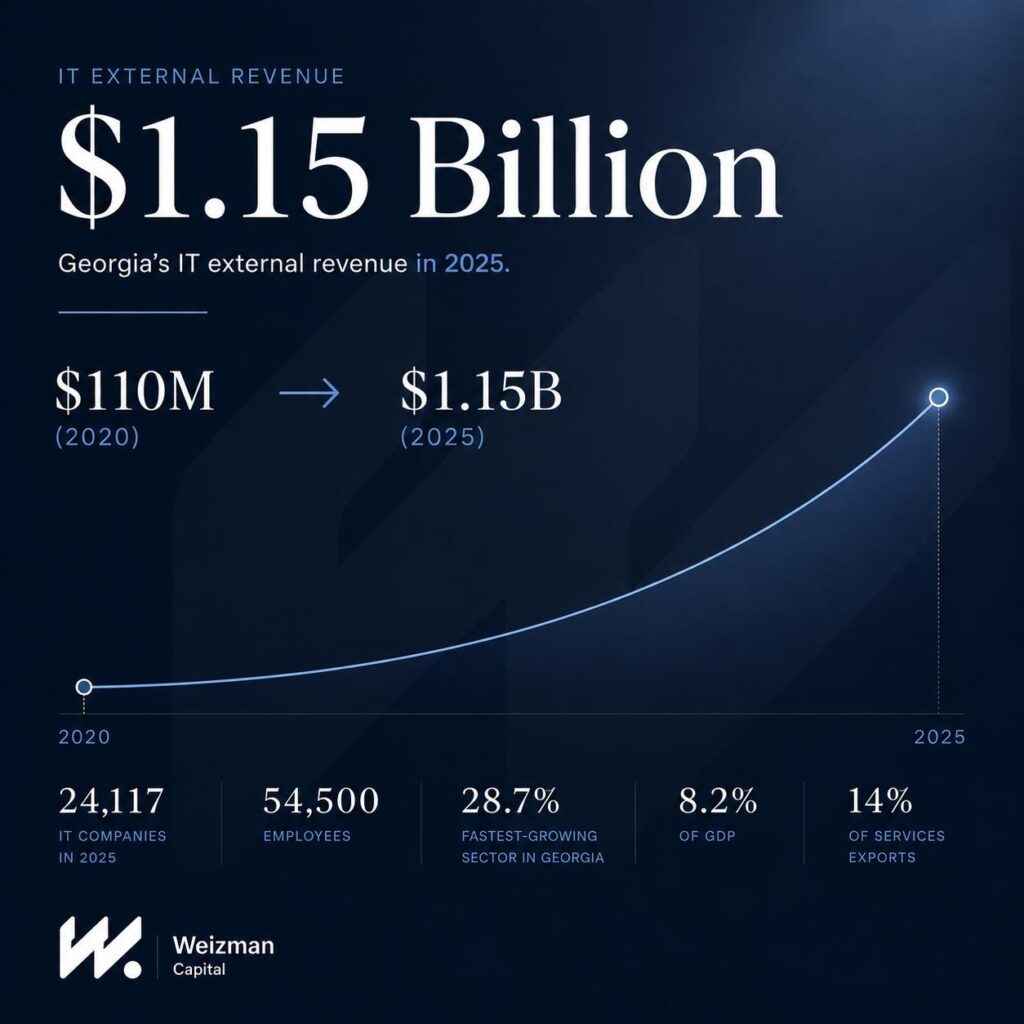
IT external revenue grew 67% in a single year. The sector now accounts for 8.2% of GDP. There are 24,117 IT companies in a country of 3.7 million people.
Every emerging market has a technology story. Accelerator programs launch. Government officials give speeches about innovation ecosystems. A few startups raise seed rounds and make headlines locally. The story rarely holds up when faced with the national accounts.
Georgia does.
In 2025, the country’s IT sector generated $1.15 billion in external revenue, reflecting a 67% year-over-year increase. The information and communication technology (ICT) sector was the fastest-growing part of the economy, expanding by 28.7% and surpassing financial services, transportation, and other industries. As of the third quarter of 2025, ICT accounted for 8.2% of nominal GDP, ranking it as the fourth-largest sector in the country. IT service exports alone increased from $110 million in 2020 to nearly $700 million in 2024, with the nine-month total in 2025 already reaching $898 million – up 52.3% compared to the previous year.
These are not venture capital metrics. They are macroeconomic data points that appear in Georgia’s current account, employment statistics, and foreign exchange inflows.
Georgia’s digital economy has moved beyond being just a policy goal and is now a fundamental part of the national economy. The question isn’t whether the sector is real anymore; it’s how to support its next stage of growth.
The Scale of the Transformation
The speed at which this has occurred is worth pausing to consider.
In 2020, Georgia had 1,971 registered IT companies. By 2024, that number increased to 24,117 – a growth of over 1,100%. 84% of these companies are international, highlighting Georgia’s rise as a hub for cross-border tech operations rather than just a local software market.
The workforce tells a consistent story. The IT sector employed about 5,000 people in 2021. By 2025, that number had increased to 54,500, making technology the highest-paying sector in the Georgian economy with an average monthly salary of GEL 4,433 in Q4 2025. GitHub registrations from Georgia rose 22% year-over-year in 2024 to 138,300, serving as a proxy for developer activity that confirms the workforce growth is genuinely substantial, not just administrative.
What makes this growth structurally interesting rather than merely impressive is the cost arbitrage that sustains it. Georgian IT salaries remain 30-40% below Central European levels for comparable skills. For international companies evaluating nearshore or offshore development centers, Georgia offers a combination of technical talent, timezone compatibility with Europe and the Middle East, and operating costs that are difficult to match in more established outsourcing destinations.
The BPO and IT outsourcing subsector now employs 46,000 people and contributes $1.67 billion in total value, with service exports exceeding $2.5 billion according to Enterprise Georgia. This is not a handful of startups generating press coverage. It is an export industry operating on an industrial scale.
The Tax Architecture That Accelerated It
Georgia did not stumble into this position. The government has put in place one of the most aggressive technology tax incentive frameworks in the world, and it is working.
The Virtual Zone program provides qualifying IT companies with 0% corporate income tax and no VAT, effectively allowing technology firms to operate in a zero-tax environment on their Georgian operations. The International Company Status offers a 5% profit tax with exemptions on property and dividends for companies serving predominantly foreign markets.
From 2025, the Innovative Startup Status introduced a tiered ten-year incentive: 0% tax for years one through three, 5% for years four through six, and 10% for years seven through ten. This is complemented by 300% R&D tax credits for innovative SMEs and 30% cashback on qualifying R&D expenditure.
The cumulative effect is that Georgia now offers technology companies a tax environment that directly competes with Ireland, Estonia, and the UAE, but with significantly lower operating costs and a regulatory framework that, for the tech sector specifically, is remarkably frictionless.
The incentive stack is not a gimmick. It is a deliberate, layered architecture designed to attract international technology operations at every stage, from early startup to scaled outsourcing to regional headquarters. The $1.15 billion in external revenue suggests it is achieving exactly what it was designed to do.
The Institutional Maturation
Beyond tax incentives, the ecosystem is institutionalizing in ways that signal durability rather than dependence on a single policy cycle.
From January 2026, Plug and Play and Startupbootcamp began operating acceleration programmes in Georgia. 500 Global and Founder Institute will launch from July 2026. GITA, Georgia’s Innovation and Technology Agency, now runs four full-scale accelerators annually, mentoring 160 startups per year. Its approximately 250 funded startups have attracted over GEL 300 million in private follow-on investment, a conversion ratio that indicates the accelerator pipeline is producing commercially viable companies, not just programme graduates.
The fintech vertical has been particularly active. Georgian fintech companies raised $39 million in 2025 alone, representing nearly 60% of all fintech funding in the country’s history. Notable investors include BlueOrchard, Insiders Ventures, and Tether’s venture arm, which invested $12 million in CityPay.io across two rounds. Open Banking, launched by the NBG, processed over 915,000 transactions between February 2025 and February 2026, with total usage exceeding 9.3 million, crossing the threshold from pilot infrastructure to genuine adoption.
The NBG’s Digital GEL pilot with Ripple, focused on programmable contracts for real estate and cross-border payments, concluded in February 2025. Draft regulations for equity crowdfunding are in sandbox. The central bank is actively building the regulatory rails for the next generation of financial technology, not reacting to it, but anticipating it.
What This Means for Investors
The IT sector’s macro relevance changes how investors should think about Georgia’s economic resilience.
An economy that generates $1.15 billion in technology exports is structurally different from one that depends on agriculture, commodities, or construction. Technology revenue is scalable without proportional capital expenditure. It is less sensitive to domestic interest rates. It generates foreign exchange inflows that support the current account and, by extension, the currency. And it creates high-wage employment that drives domestic consumption and tax revenue.
For the current account specifically, ICT exports now represent 14% of total services exports, a share that has grown from negligible to material in under five years. This diversification is one of the reasons the current account deficit narrowed to 2.9% of GDP in 2025, and it provides a buffer against the kind of terms-of-trade shocks that historically destabilised Georgia’s external balance.
For direct technology investment, the combination of the tax framework, the talent pool, and the cost arbitrage creates a window that will not remain open indefinitely. As salaries rise and the sector matures, the current pricing advantage will compress. The investors who benefit most will be those who deploy capital while the arbitrage is still wide and the infrastructure is already proven.
Georgia’s technology sector is no longer a bet on potential. It is a $1.15 billion export industry with institutional infrastructure, international accelerators, and a regulatory framework that is actively facilitating the next stage of growth.
Conclusion: The Balance of Payments Does Not Lie
Startup ecosystems can be superficial. Government innovation programs can be merely surface-level. But when a sector appears in the national accounts, within GDP composition, export data, employment statistics, and current account figures, the conversation shifts from narrative to evidence.
At Weizman Capital, we see Georgia’s technology sector as the most undervalued structural change in the country’s economy. It is transforming the labor market, broadening the export base, improving the external balance, and creating a new class of investable assets that didn’t exist five years ago.
The balance of payments is accurate. So is the $1.15 billion in external revenue.