
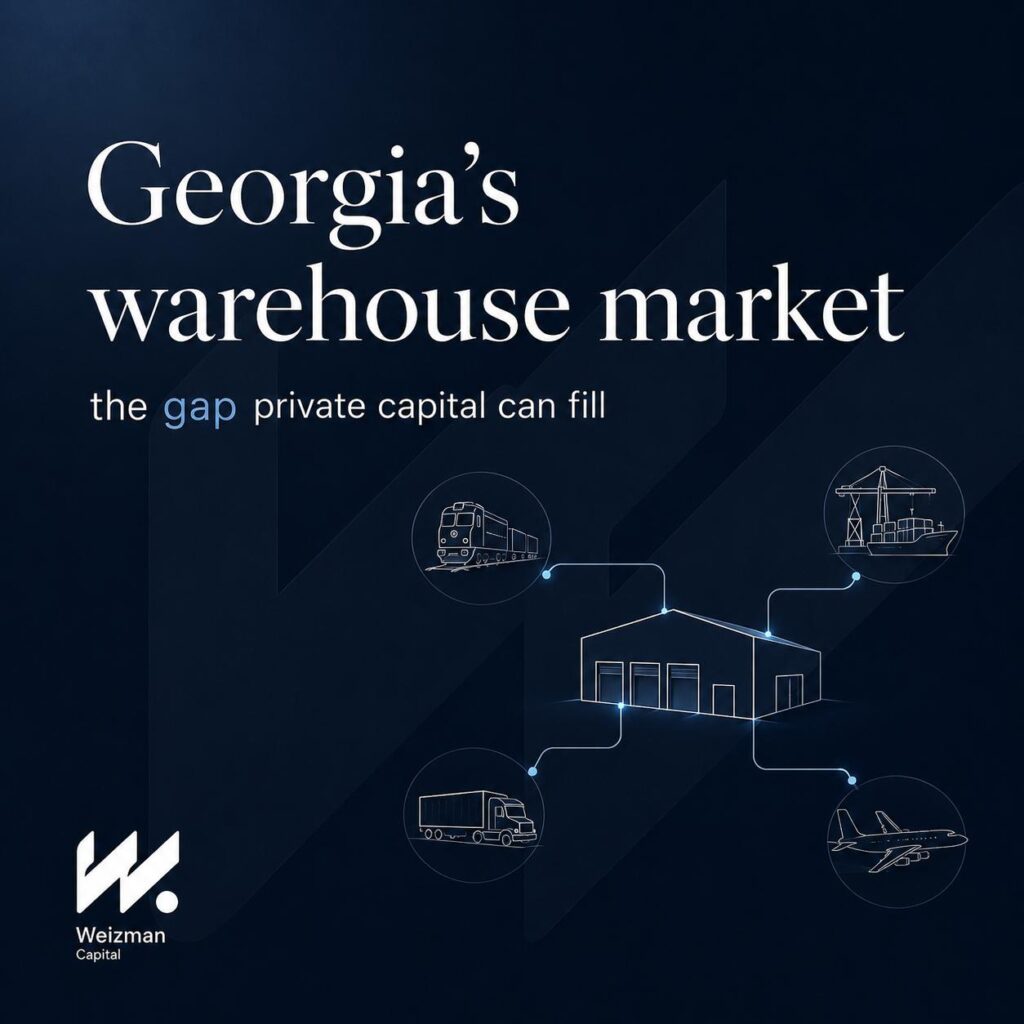
Georgia’s logistics investment thesis isn’t focused on shipping lanes or geopolitical corridors. It centers on 920,000 square meters of warehouse space, 6% cold storage penetration, and a market where most companies still prefer not to outsource.
The Middle Corridor has become one of the most discussed trade routes in global logistics discussions. Container volumes are increasing rapidly. Governments are signing transit agreements. Multilateral organizations are publishing strategy papers. Georgia, located at the corridor’s western end, plays a prominent role in every narrative.
However, for private capital seeking deployable, yield-driven logistics investments in Georgia, the corridor story is mostly irrelevant. Shipping lanes generate transit fees, but they do not, on their own, deliver the recurring, operationally intensive returns that institutional investors look for. The investable opportunity in Georgian logistics isn’t on the water or on the rail; it’s on land, in the warehouses, cold-chain facilities, and third-party logistics services that the country notably lacks.
The Middle Corridor transports cargo through Georgia. The investment case concerns what happens to that cargo once it arrives and the infrastructure gap that currently prevents Georgia from capturing more value from it.
The Supply Picture
Galt & Taggart’s warehousing research offers the clearest snapshot of the current market. Total warehouse supply in Tbilisi is approximately 920,000 square meters. Of that, 94% is dry storage, and just 6% is temperature-controlled cold chain capacity.
The quality profile is just as revealing. The market remains fragmented and led by small-scale operators, many of whom occupy converted Soviet-era industrial buildings that fail to meet the standards required by multinational tenants. ESG-compliant, Grade-A facilities with smart energy management, automated inventory systems, and cold-chain capabilities are almost non-existent on a commercial scale.
New supply is on the way: Galt & Taggart predicts a 33% rise in warehouse stock by the end of 2026, mainly at a higher quality level than existing inventory. However, this new supply is focused on dry storage and general-purpose facilities. The cold-chain shortfall, which is most critical for food logistics, pharmaceutical distribution, and agricultural export processing, remains mostly unaddressed.
For context, new dry-warehouse lease rates are around $5–6 per square meter, competitive within the region but reflecting the generally low quality of most existing stock. Grade-A facilities, when available, command a premium that the market has only just begun to explore.
Why 3PL Adoption Remains Low
The most intriguing aspect of Georgia’s logistics market isn’t what the data shows. It’s what the survey reveals about behavior.
Galt & Taggart’s research indicates that most Georgian companies still prefer to handle logistics internally rather than outsourcing to third-party providers. Companies aiming to expand their warehouse capacity in the next few years mainly plan to build their own facilities rather than lease from specialized operators. The cultural and structural preference for vertical integration, owning trucks, warehouses, and distribution networks, remains deeply ingrained in Georgian business practices.
This is not irrational. In a market where professional 3PL services are scarce, unreliable, or poorly standardized, keeping logistics in-house is a rational choice due to an underdeveloped supplier network. Companies cannot outsource to providers that do not yet meet the required quality standards.
But for investors, this behavioral pattern presents an opportunity. Low 3PL penetration in a growing economy indicates a pre-institutional market condition, similar to the circumstances that sparked the logistics outsourcing wave in Poland in the 2000s, Turkey in the 2010s, and more recently across Southeast Asia. The catalyst for the transition is typically a combination of rising labor costs, increasing supply chain complexity, and the entry of international operators who establish a new quality standard.
All three conditions are emerging in Georgia. Construction wages surged 16.7% year-over-year in 2025. Middle Corridor freight volumes through Georgia reached 76,900 TEUs in 2025, up 36%, with container traffic from China via the Trans-Caspian route increasing 25-fold between 2023 and 2024. And international operators are arriving.
The 3PL gap is not a market failure; it’s a market that hasn’t yet been built. The economics of developing it, in a country where trade volumes are growing at double-digit rates and domestic operators lack the capital or expertise to professionalize, favor the first institutional entrants.
The Institutional Operators Already Moving
The early movers support the thesis.
AD Ports Group, the Abu Dhabi-based infrastructure operator, inaugurated Georgia’s first bonded container and intermodal terminal in June 2025. Phase 2 launched in early 2026, expanding capacity to 200,000 TEUs and adding a 9,800-square-meter Class A warehouse alongside additional container yards and a fourth rail spur. This is not a speculative development. It is a UAE sovereign-adjacent infrastructure company deploying capital into Georgian logistics at operational scale.
Gebrüder Weiss, the Austrian logistics firm, has completed its third expansion in Tbilisi, bringing its total footprint to 142,000 square metres of warehousing. Over five years, the facility has processed 130,000 shipments and 470,000 tonnes of cargo. The continued expansion by an established European operator is a market signal: the volumes justify the investment, and the competitive landscape remains open enough to support growth.
These operators are building the quality benchmark that the market currently lacks. As their facilities demonstrate what professional warehousing and integrated logistics actually look like, in terms of throughput, reliability, and cost-efficiency, the case for outsourcing becomes progressively harder for Georgian companies to ignore.
Connecting the Dots: Trade Growth, Port Capacity, and Inland Infrastructure
The warehousing opportunity does not exist in isolation. It sits within a broader infrastructure cycle that is compressing timelines.
Anaklia deep-sea port construction is underway, with Phase 1 targeting 900,000 TEUs plus 1.5 million tonnes of dry bulk capacity. Major dredging is scheduled for mid-2026, with breakwater completion targeted for May 2027. The Baku-Tbilisi-Kars railway modernisation is 98.5% complete, increasing the Georgian section’s capacity from 1 million to 5 million tonnes annually. Tbilisi International Airport is undergoing a $150 million expansion to double passenger capacity. A new greenfield airport east of Tbilisi was formally launched by government decree on April 2, 2026, with Phase 1 capacity of 10 million passengers.
Each of these projects increases the volume of goods and people moving through Georgia. None of them, by themselves, solve the last-mile problem of where that cargo is stored, processed, sorted, and distributed once it reaches Georgian territory. That gap, between trunk infrastructure and operational logistics, is where private capital earns its return.
The state is building the ports, railways, and airports. The opportunity for private investors is in everything between those nodes: the warehouses, cold-chain facilities, and distribution infrastructure that convert transit volumes into locally captured economic value.
Conclusion: The Unsexy Thesis
Warehousing isn’t a glamorous investment idea. It doesn’t make headlines or conference keynote speeches. However, in an economy where trade volumes are growing rapidly, infrastructure is being expanded quickly, and the local logistics market remains fragmented, underfunded, and lacking in outsourcing, it is one of the most resilient real-asset opportunities out there.
At Weizman Capital, we view Georgia’s logistics infrastructure deficit as a classic pre-institutional market, similar in structure to what international operators encountered in Central and Eastern Europe fifteen years ago. The demand is quantifiable. The supply gap is documented. The early institutional entrants are already deploying. And the behavioral shift from in-house logistics to professional outsourcing, once it begins, tends to accelerate rather than plateau.
The cargo is already moving through Georgia. The question is who builds the infrastructure that captures value from it.